
Part 2 of Understanding Your Cycle
Now that we've talked about why your menstrual cycle provides such valuable information about your health, let's answer the next question:
What does an optimal menstrual cycle actually look like?
Most women are never taught what an optimal menstrual cycle should look like. I certainly wasn't. I didn't learn this until I was in my twenties, and honestly, I think it's one of the most empowering things women can understand about their bodies. It's hard to know when something isn't working well if you've never been shown what "well" looks like.
Much of what we learn about periods comes from conversations with friends, family members, or what we've been told is "normal." But normal often means common or average—not necessarily healthy or optimal.
What I'm about to describe isn't the average menstrual cycle. It's what we consider an optimal menstrual cycle—a body functioning as efficiently as possible.
Very few people check every single box, and that's okay. This isn't about chasing perfection. It's about understanding where your body is today so we know what direction we're trying to move.
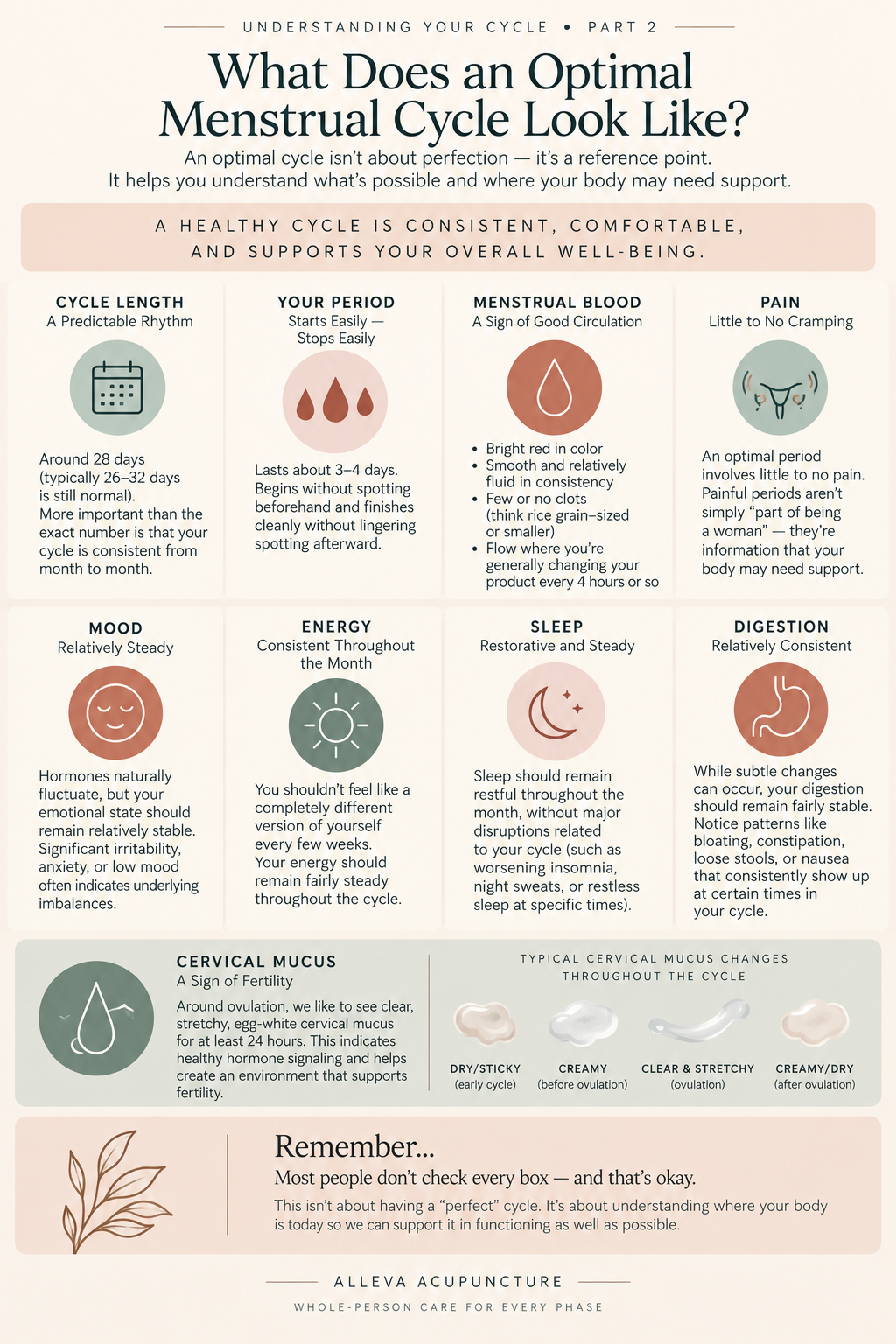
Cycle Length: An Optimal Cycle Has a Predictable Rhythm
In Chinese medicine, an optimal menstrual cycle is generally around 28 days, plus or minus a day or two. More important than the exact number is that your cycle has a consistent rhythm that repeats month after month.
Your Period Starts Easily—and Stops Easily
An optimal period typically lasts about three to four days.
It begins without spotting beforehand and finishes cleanly without lingering spotting afterward.
While this may seem like a small detail, spotting before or after your period often tells us something about how your body is functioning.
Period Color and Clots: What Healthy Menstrual Blood Looks Like
Yes—we actually pay attention to the blood itself.
The color, consistency, and presence of clots all provide valuable information.
Ideally, menstrual blood is:
Bright red in color
Smooth and relatively fluid in consistency
Has very small or no clots (think rice grain sized or smaller)
Flows at a rate where you're generally changing your menstrual product every four hours or so
This may feel like an unusual thing to observe, but it's one of the most useful pieces of information you can share with your practitioner.
And yes—we happily accept pictures. It may feel a little strange, but they can actually be incredibly helpful.
If you regularly notice larger clots, especially with cramps that feel better with a heating pad, I talk about one common pattern behind that in What Is a Cold Womb?
Period Pain: Little to No Cramping
This one surprises almost everyone.
Painful periods have become so normalized that many women assume they're simply part of having a menstrual cycle. From a Chinese medicine perspective, however, an optimal period should involve little to no cramping.
That doesn't mean we expect everyone to be pain-free overnight. But it does mean that painful periods aren't something we simply accept as inevitable.
If your pain is severe or getting worse over time, please mention it to your doctor or gynecologist too. Conditions like endometriosis and fibroids are worth ruling out, and acupuncture can support your cycle alongside that care.
Your Mood Shouldn't Be on a Roller Coaster
Hormones naturally fluctuate throughout your cycle, but ideally your emotional state remains relatively steady.
If you regularly experience significant irritability, anxiety, or depression around certain parts of your cycle, that's something we pay attention to. Those changes often give us important clues about what's happening beneath the surface.
Your Energy Should Stay Relatively Consistent
Likewise, your energy should remain fairly steady throughout the month.
You shouldn't feel like you become a completely different version of yourself every few weeks.
Your body should have the resources to move through each phase of the menstrual cycle without dramatic highs and lows in energy.
Sleep and Digestion Should Stay Consistent
Your menstrual cycle doesn't just affect your reproductive system—it can influence your entire body.
Sleep should remain restful throughout the month.
Digestion should stay relatively consistent.
If you notice worsening bloating, constipation, diarrhea, restless sleep, night sweats, or other symptoms that appear at specific times in your cycle, those patterns become valuable information. Timing often tells us just as much as the symptom itself.
Healthy Cervical Mucus Around Ovulation
For women trying to conceive, cervical mucus becomes another important marker.
Around ovulation, we like to see clear, stretchy, egg-white cervical mucus for at least 24 hours.
This tells us your body is creating an environment that supports fertility. It's one of the details we look at closely in fertility and pregnancy support.
Looking at the Whole Picture
When I sit down with a patient, I'm rarely focused on just one symptom. I'm looking at how all of these pieces fit together.
Where is your body doing exactly what we'd expect?
Where is it working harder than it needs to?
Which patterns keep showing up month after month?
Those patterns tell us where to start.
If you're reading this and thinking, "Well...none of this sounds like my cycle," don't panic. Most women I see don't have an optimal cycle when they first come into the clinic. That's exactly why we evaluate it. Your cycle gives us a starting point and helps us understand where your body may need support.
As we begin improving those underlying patterns, many women are surprised by what changes—not just their periods, but their sleep, energy, mood, digestion, and overall sense of well-being.
That's why we spend so much time talking about the menstrual cycle. It isn't just about your period. It's one of the clearest windows we have into how your body is functioning as a whole.
In Part 3, we'll talk about how to track your menstrual cycle and which details are most helpful to record. Good tracking helps both you and your acupuncturist recognize patterns that might otherwise go unnoticed.
Menstrual Cycle Support in Fairfax, VA
If you'd like help understanding what your cycle is telling you, I'd love to look at it with you. Alleva Acupuncture is in Fairfax, near the Mosaic District, and just minutes from Falls Church.
Book an appointment with Alleva Acupuncture
Disclaimer: This article is for educational purposes and isn't a substitute for medical advice. If you have very heavy bleeding, severe pain, bleeding between periods, or a sudden change in your cycle, please check in with your doctor or gynecologist.
Frequently Asked Questions
How long is an optimal menstrual cycle?
In Chinese medicine, an optimal cycle is around 28 days, give or take a day or two. More important than the exact number is a consistent rhythm that repeats month after month.
What color should period blood be?
Ideally, period blood is bright red, smooth and fairly fluid, with very small clots or none at all. Darker blood, brown spotting, or regular clots larger than a grain of rice are patterns worth discussing with your practitioner.
Are period cramps normal?
Period cramps are common, but from a Chinese medicine perspective they aren't optimal. An optimal period involves little to no cramping, and severe or worsening pain is also worth raising with your doctor.
What if my cycle doesn't look like this?
That's very common. Most women don't have an optimal cycle when they first come to our clinic. We see these differences as information worth paying attention to. Your menstrual cycle is one of the ways your body communicates how it's functioning, and understanding those patterns can help us identify where support may be beneficial.