
Part 3 of Understanding Your Cycle
By now, we've talked about why your menstrual cycle is such a valuable window into your health and what an optimal menstrual cycle looks like.
The next step is learning how to observe your own cycle.
Observing your symptoms over time is one of the most valuable things you can do—not just if you're trying to conceive, but if you simply want to understand your body better. One of the best things you can bring to an appointment is good information about how your body has been functioning.
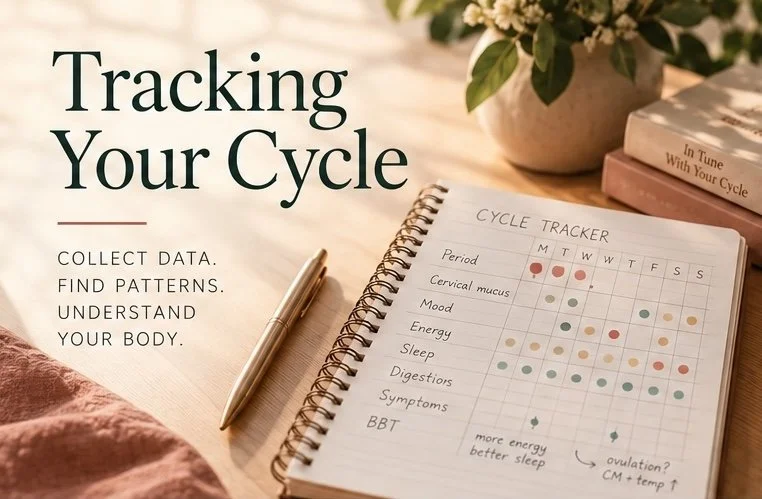
At First, It's Just About Collecting Data
When we start tracking your menstrual cycle, we're collecting data—not trying to diagnose ourselves.
The reality is that you can't understand very much from a single menstrual cycle. One month can be unusual for all kinds of reasons. Stress, travel, illness, changes in sleep, nutrition, exercise, or major life events can all influence what happens during a given month.
By about three cycles, we can usually start to see patterns. Six months gives us an even better understanding of what's normal for your body and how much natural variation you experience from month to month.
For those trying to conceive or living with painful cycles, waiting several months can feel frustrating. But I promise the understanding is worth the effort. In the beginning, try your best to simply observe and record what you notice without worrying about what it means. Interpreting the information comes later. For now, your job is simply to notice.
What to Track in Your Menstrual Cycle
Here are the things I find most helpful when evaluating a menstrual cycle.
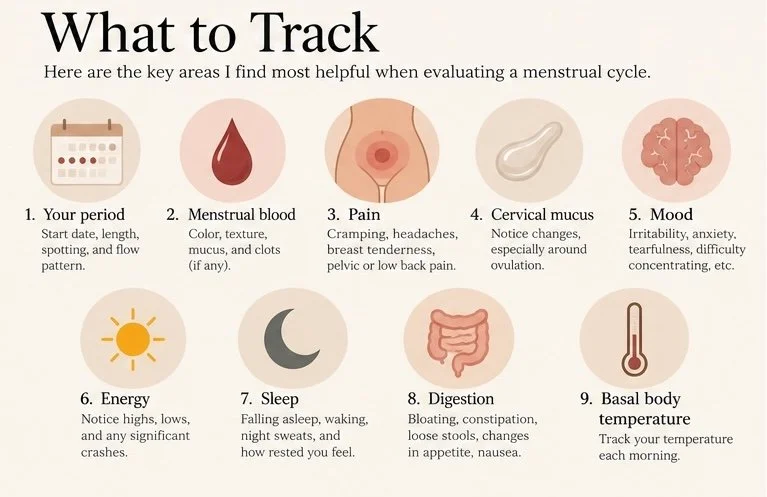
1. Your Period
Record:
The first day your period begins
How many days you bleed
Whether it starts and stops cleanly
Any spotting before or after your period
Almost every healthcare provider will ask when your last period started, so this is a great place to begin.
2. Your Menstrual Blood
This is probably the part that makes people laugh.
Yes... I really do want you to look at your menstrual blood.
It isn't strange.
It isn't gross.
It's information.
Notice:
The color (bright red, dark red, brown, pink, or another color)
Whether it's watery or thick
Whether you notice mucus (sometimes this is easiest to see when the blood sits on top of the toilet paper)
Whether there are clots
If there are clots, approximately how large they are
These observations provide valuable clues about what's happening inside the body.
3. Pain
Notice whether you experience:
Cramping
Low back pain
Headaches
Breast tenderness
Pelvic discomfort
Pain is never something I consider "normal" simply because it happens every month.
Just as importantly, record when the symptoms occur. Symptoms before your period often tell a different story than symptoms during or after your period. Timing matters just as much as the symptom itself.
4. Cervical Mucus
This is one of the most overlooked parts of cycle tracking.
Around ovulation, begin paying attention when you wipe after using the bathroom.
Do you notice cervical mucus?
Is it:
Clear?
Stretchy?
Slippery?
Similar to raw egg whites?
If you're trying to conceive, this becomes especially valuable information and can help support verification of ovulation alongside other signs or tests.
5. Mood
Rather than simply writing "PMS," try to be more specific.
Did you notice:
Irritability?
Anxiety?
Feeling tearful?
Feeling overwhelmed?
Difficulty concentrating?
Again, pay attention to when these symptoms occur. Timing often tells me as much as the symptoms themselves.
6. Energy
Notice your energy throughout the month.
Do you generally feel steady, or do you notice significant crashes around ovulation or before your period?
Your menstrual cycle shouldn't feel like an emotional or physical roller coaster.
7. Sleep
Pay attention to changes such as:
Difficulty falling asleep
Waking during the night
Night sweats
Restless sleep
How rested you feel when you wake up
These details often become surprisingly helpful when we're looking for patterns.
8. Digestion
Many women notice changes in digestion during different phases of their cycle.
Track things like:
Bloating
Constipation
Loose stools
Changes in appetite
Nausea
Again—always note when it happens.
9. Basal Body Temperature
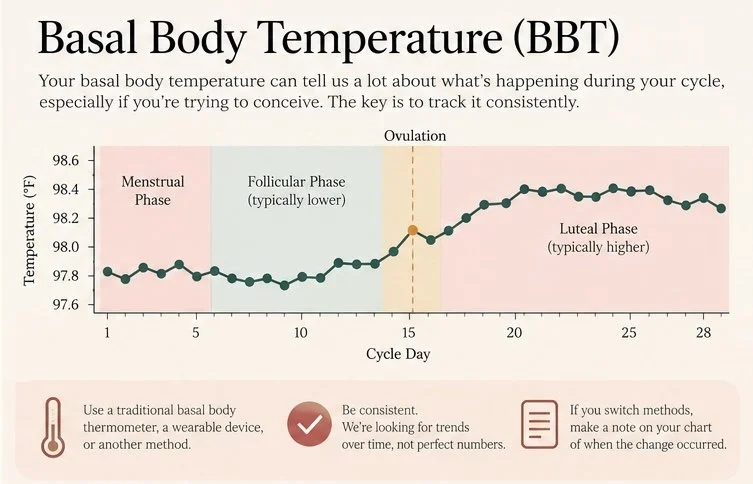
I really love this piece of data. I think it tells us an incredible amount about what's happening during your cycle, but I also know it's one that many women struggle to stick with. If you're trying to conceive, I do highly recommend tracking it because it can provide another valuable layer of information.
Some women prefer using a traditional basal body thermometer each morning. Others use wearable devices such as the Oura Ring or continuous temperature sensors.
There's no one "right" method. Whatever you choose, use it consistently. Changing methods can affect your data, so if you do need to switch, make a note on your chart of when the change occurred.
The most important thing is consistency. We're looking for trends over time, not perfect numbers.
How Should You Track Your Cycle? Apps, Charts and Wearables
People often ask whether they should use a period tracking app. My answer is simple: if it helps you stay consistent, absolutely. A few apps I've found helpful over the years are Natural Cycles, Kindara, and Read Your Body. Each approaches tracking a little differently, but all offer ways to record more than just the dates of your period. If you're interested in tracking basal body temperature, cervical mucus, and other symptoms, they're worth exploring.
You can also use a notebook, a spreadsheet, or one of the many paper charts available. Toni Weschler's Taking Charge of Your Fertility is a great resource if you're looking for paper charting options.
Whatever method you choose, make sure it allows you to record more than just your period. Ideally, you'll have a place to track all of the symptoms we've discussed.
One thing I'd recommend: if you're using an app, turn off the prediction features while you're first collecting data. Early on, those predictions are based on population averages rather than your body's actual patterns. I'd much rather have you learn to recognize your own signs of ovulation and menstruation than rely on an app to tell you when it thinks they should happen.
We're interested in your cycle—not the average cycle.
You can always turn those prediction features back on later. Once the app has learned your cycle, they're often much more accurate. In the beginning, though, I find they tend to confuse people more than they help.
Keep It Consistent
For most people, this is the hardest part—simply creating the habit.
Give yourself a little grace in the beginning. You won't be perfect, but try to set the intention to record your observations every day. Over time, it becomes second nature.
If you miss a day here and there, don't worry. It doesn't make the rest of your data unusable. Just pick back up where you left off.
You're Learning Your Body's Language
Learning to track your cycle isn't about becoming obsessed with every little symptom. It's about becoming familiar with what is normal for your body. Once you know your baseline, changes become much easier to recognize, and the tracking starts to feel like less work. It also makes it easier to spot a real change that's worth raising with your doctor.
When patients come into the clinic with several months of tracking, it gives me far more information than trying to remember what happened over the last few cycles. Those patterns often help explain why symptoms are occurring and allow us to create a treatment plan that's tailored specifically to you, whether you're working on fertility or painful periods, PMS and other cycle concerns.
Bring Your Cycle Chart to Alleva Acupuncture in Fairfax
Whether you've been tracking for six months or you're just getting started, I'd love to look at your cycle with you. Alleva Acupuncture is in Fairfax, near the Mosaic District, and we see women from all over Northern Virginia.
If you've never had acupuncture before, here's what to expect at your first visit.
Book an appointment with Alleva Acupuncture
Disclaimer: This article is for educational purposes and isn't a substitute for medical advice. Cycle tracking helps you notice patterns; it doesn't replace testing or care from your doctor. If you have very heavy bleeding, severe pain, bleeding between periods, or a sudden change in your cycle, please check in with your doctor or gynecologist.
Frequently Asked Questions
How many cycles should I track before I see patterns?
About three cycles is usually enough to start seeing patterns, and six months gives an even clearer picture of what's normal for your body. A single month can be thrown off by stress, travel, illness or changes in sleep.
What should I track besides my period dates?
Pay attention to how much you bleed, the color and texture of your menstrual blood, any clots or cramping, changes in vaginal discharge (cervical mucus), and patterns in your mood, energy, sleep, and digestion. If you're interested in tracking ovulation, you can also record your basal body temperature (your temperature first thing in the morning, before getting out of bed). Try to note when these changes happen throughout your cycle. The timing of a symptom can often tell us just as much as the symptom itself.
Should I use a period tracking app?
Yes, if it helps you stay consistent. Choose one that records more than your period dates, and consider turning off prediction features at first so you learn your own signs instead of relying on the app's estimates.