
What Your Menstrual Cycle Can Tell You About Your Health
Part 1 of Understanding Your Cycle
When patients come to our clinic for fertility support, one of the first questions they ask is:
"How does Chinese medicine treat fertility?"
My answer usually surprises them.
We aren't just treating fertility—we're working toward optimal health.
Fertility is one expression of a healthy body. When the systems that support overall health are functioning well, fertility often improves alongside them. Rather than focusing on a single symptom or diagnosis, we're asking a broader question: How can we help your body function as well as it possibly can?
One of the most valuable tools we have for answering that question is your menstrual cycle.
Your Cycle Is More Than Just Your Period
The first thing to understand is that your menstrual cycle is much more than your period.
In Chinese medicine, we look at the entire cycle—from the first day of bleeding until the day before your next period begins. Every phase provides information about how your body is functioning.
Your cycle gives us clues about:
how your hormones are regulating
how Blood is circulating and nourishing your body
how efficiently you're producing and using energy
how well your body recovers
how fluids are being produced and moving through your body
Sometimes I joke that I wish men had something similar. It would make our jobs much easier.
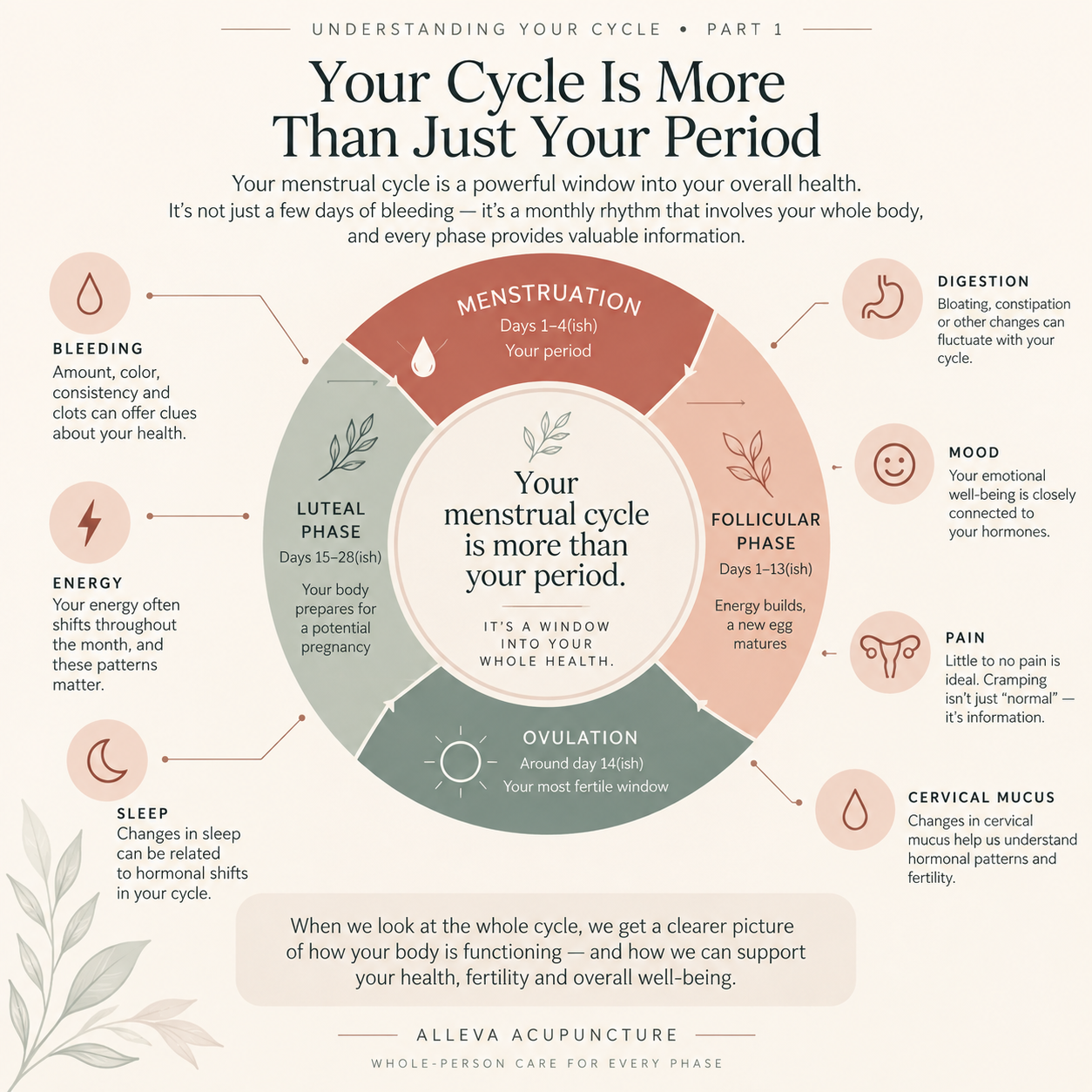
Your menstrual cycle includes much more than your period. Changes in bleeding, pain, mood, energy, sleep, digestion and cervical mucus can all provide useful information about your health.
What's Common in a Menstrual Cycle Isn't Always Optimal
One of the biggest misconceptions I see is that many women assess their menstrual cycles by what is common instead of what is optimal.
We've become accustomed to hearing things like:
"Cramps are just part of being a woman."
"The women in my family all have heavy periods."
"Everyone gets emotional before their period."
"I'm always exhausted during my period."
These experiences are certainly common. But common doesn't necessarily mean healthy.
One of the things I love most about Chinese medicine is that we're not simply asking whether your cycle falls within a broad range of what's considered "normal."
We're asking a different question:
How close is your body functioning to its fullest potential? And how can we help it get there?
That shift in perspective changes the conversation completely.
Your Symptoms Are Valuable Information
Chinese medicine places tremendous value on symptoms.
Rather than dismissing them because they're common or because your lab work is normal, we use them as clues to understand how your body is functioning.
Cramping. Spotting. Clotting. Mood changes. Sleep disturbances. Digestive changes. Headaches or migraines. Fatigue.
Many women have experienced these symptoms for so long that they've come to accept them as simply part of having a menstrual cycle. To us, they're pieces of a much larger picture. They help us recognize patterns and guide treatment toward what's happening underneath the symptoms.
One of my favorite parts of practicing Chinese medicine is helping women recognize these patterns for themselves. Once you know what an optimal cycle can look like, you may begin to notice things you've accepted for years as "just the way your body works."
That knowledge gives you more agency in your healthcare and helps you become a more informed participant in your health.
None of this means something is "wrong" with you if your cycle doesn't look perfect. It simply means your body is giving you information. Our job is to learn how to interpret it and help your body function as well as it can.
Looking Beyond Fertility
Although we use menstrual cycle analysis extensively when helping patients conceive, these conversations aren't just for women trying to get pregnant.
Whether you're in your twenties or approaching menopause, your menstrual cycle reflects the health of your entire body—not just your reproductive system.
Learning to understand those patterns gives you a deeper understanding of your own health and allows us to work together toward something more than simply managing symptoms. It allows us to work toward optimal health.
In the next article, we'll explore what an optimal menstrual cycle actually looks like—and why so many women are surprised to discover what's possible.